
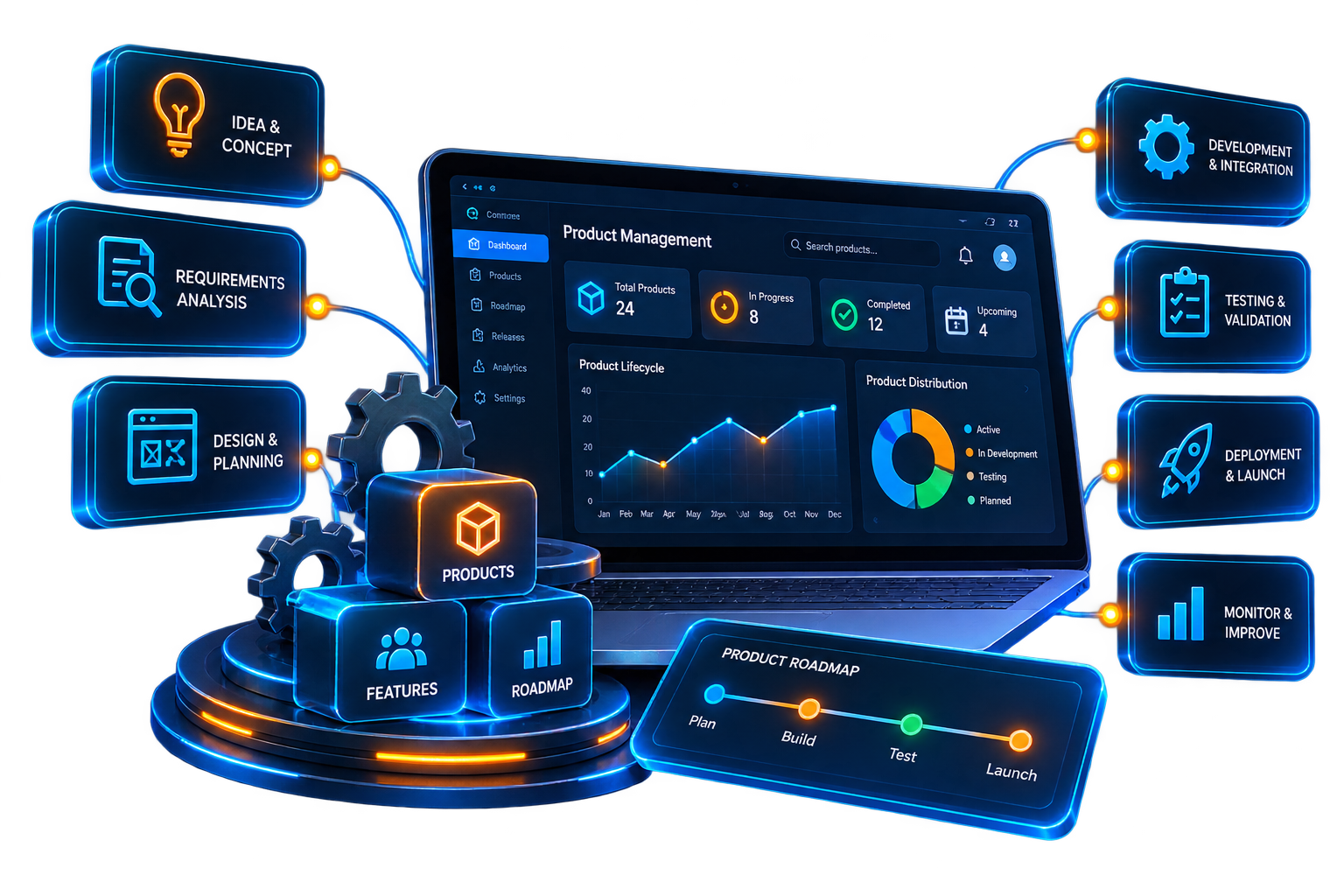
PRODUCT LIFECYCLE MANAGEMENT
Manage products from discovery and development through launch, growth, optimization, maturity, and retirement.
Product Lifecycle Management
Manage products from discovery and development through launch, growth, optimization, maturity, and retirement. Our product management approach connects strategy, customer insight, execution, and measurable outcomes to help organizations build and improve successful digital products.
-
Define clear objectives and requirements for product lifecycle management.
-
Align customer needs, business priorities, and delivery activities around product lifecycle management.
-
Use structured planning, measurable outcomes, and continuous feedback to improve results.
-
Create a scalable approach that supports long-term product success and operational efficiency.
A Step-by-Step Guide to Effective Product Lifecycle Management
Product lifecycle management provides a structured approach for managing a product throughout every stage of its existence. From initial discovery and development to launch, growth, maturity, and retirement, each stage requires different strategies, priorities, and performance measures.
-
Product Discovery: Identify customer needs, market opportunities, business requirements, and potential product ideas.
-
Product Planning: Define product objectives, target customers, value proposition, roadmap, resources, and expected outcomes.
-
Product Development: Translate validated requirements into product features, technical solutions, and deliverable increments.
-
Testing and Validation: Validate functionality, usability, performance, security, and customer expectations before launch.
-
Product Launch: Coordinate product readiness, go-to-market activities, customer communication, sales enablement, and operational preparation.
-
Growth and Adoption: Improve customer acquisition, onboarding, engagement, feature adoption, and retention.
-
Maturity and Optimization: Improve product performance, customer experience, efficiency, and profitability as the product matures.
-
Retirement: Determine when a product or capability should be replaced, discontinued, migrated, or transitioned to another solution.
Key Critical Factors for Successful Product Lifecycle Management
Managing the product lifecycle effectively requires organizations to continuously balance customer expectations, business objectives, technology, market conditions, and product performance. Strong lifecycle management keeps the product aligned with changing opportunities.
-
Clear Product Vision: Establish a strong product direction that guides decisions throughout the lifecycle.
-
Customer-Centered Decisions: Use customer needs, feedback, research, and behavior to guide product improvements.
-
Lifecycle-Based Planning: Adapt product priorities according to the current stage of the product lifecycle.
-
Cross-Functional Collaboration: Align product, development, marketing, sales, operations, and support teams.
-
Data-Driven Management: Use product analytics and business metrics to understand performance and guide decisions.
-
Continuous Innovation: Identify new opportunities to improve the product and maintain market relevance.
-
Scalability and Sustainability: Build processes and technology that can support long-term product growth.
Looking for Product Lifecycle Management solutions?
Manage every stage of your product lifecycle with structured planning, customer-focused strategy, continuous optimization, and measurable outcomes.
Contact UsCommon Product Lifecycle Management Challenges and How to Address Them
Products can lose momentum when teams fail to adapt their strategy as the product moves through different lifecycle stages. Effective lifecycle management helps organizations identify challenges early and respond with the appropriate product strategy.
-
Changing Customer Needs: Continuously collect customer feedback and monitor behavior to keep the product relevant.
-
Unclear Product Direction: Maintain a clear product vision, roadmap, and measurable objectives.
-
Slow Product Development: Improve prioritization, collaboration, delivery processes, and technical capabilities.
-
Declining Product Adoption: Improve onboarding, usability, customer education, engagement, and feature discovery.
-
Increasing Competition: Monitor market changes and continuously improve product differentiation and value.
-
Legacy Technology: Plan technical modernization, scalability improvements, security updates, and technical debt reduction.
-
Product Decline: Evaluate declining performance and determine whether optimization, repositioning, replacement, or retirement is appropriate.
Product Discovery and Development Management
The early stages of the product lifecycle establish the foundation for long-term success. Strong discovery and development processes help teams validate opportunities, understand customer problems, and build products that deliver meaningful value.
-
Conduct customer and market research to identify meaningful product opportunities.
-
Define clear product requirements and measurable objectives.
-
Validate concepts and assumptions before committing significant development resources.
-
Prioritize features based on customer value, business impact, effort, and strategic importance.
-
Use iterative development and customer feedback to improve the product throughout development.
Product Launch, Growth, and Adoption
After development, products need strong launch execution and ongoing growth strategies. Product teams must monitor customer adoption, engagement, retention, and market response to identify opportunities for improvement.
-
Establish launch readiness criteria and coordinate product, marketing, sales, and support activities.
-
Communicate product value clearly to target customers and market segments.
-
Monitor acquisition, activation, adoption, engagement, and retention after launch.
-
Identify barriers to adoption and improve onboarding and customer experience.
-
Use customer feedback and product analytics to guide growth initiatives.
Want to optimize your product throughout its lifecycle?
Connect product strategy, customer insights, development, launch, adoption, growth, and optimization to maximize long-term product value.
Get StartedProduct Maturity and Continuous Optimization
As a product matures, customer expectations, competitive conditions, technology, and business priorities continue to change. Continuous optimization helps mature products maintain relevance and improve efficiency and customer value.
-
Monitor product usage and identify areas where customer experience can be improved.
-
Optimize product performance, usability, reliability, and operational efficiency.
-
Introduce new capabilities when they provide meaningful customer or business value.
-
Improve existing features based on customer feedback and product analytics.
-
Evaluate competitive changes and emerging technologies that may affect the product.
Product Retirement and Transition Planning
Product retirement is an important part of lifecycle management when a product no longer provides sufficient value or when a better replacement solution becomes available. A structured transition approach helps protect customers and business operations.
-
Analyze product performance, customer usage, maintenance costs, and strategic relevance.
-
Determine whether optimization, modernization, replacement, or retirement is the appropriate path.
-
Develop migration and transition plans for existing customers.
-
Communicate retirement timelines and available alternatives clearly to customers and stakeholders.
-
Maintain appropriate support and operational processes throughout the transition period.
Ready to manage your complete product lifecycle?
Build a lifecycle strategy that helps your products evolve with customer needs, market opportunities, technology, and business goals.
Talk to Our ExpertsHow to Measure Product Lifecycle Management Effectiveness
Measuring lifecycle performance helps organizations understand how effectively products are progressing through different stages and whether product investments are generating meaningful customer and business outcomes.
-
Product Adoption: Measure how effectively customers adopt and use the product.
-
Customer Engagement: Track usage frequency, feature engagement, and customer interaction.
-
Retention: Monitor customer retention, renewal, and long-term product usage.
-
Revenue Performance: Evaluate revenue growth, customer value, and profitability throughout the product lifecycle.
-
Product Quality: Monitor defects, reliability, performance, support requirements, and customer satisfaction.
-
Innovation Performance: Measure the impact of new features, enhancements, and product improvements.
-
Lifecycle Efficiency: Evaluate development speed, operational costs, resource utilization, and overall product efficiency.
Continuous Improvement of Product Lifecycle Management
Product lifecycle management should continuously evolve based on customer feedback, market changes, product performance, technology, and business strategy. Regular reviews help organizations make better decisions at every stage of the product lifecycle.
-
Review product performance regularly across all lifecycle stages.
-
Analyze customer feedback, usage patterns, market trends, and competitive changes.
-
Reassess product strategy and roadmap as business and customer priorities evolve.
-
Identify opportunities for new features, optimization, modernization, or repositioning.
-
Improve processes across product discovery, development, launch, growth, and support.
-
Establish repeatable lifecycle management practices that support long-term product success.
Maximize Product Value Across Every Lifecycle Stage
From discovery and development to launch, growth, maturity, optimization, and retirement, create a structured product lifecycle management approach that supports sustainable business growth.
Contact UsPRODUCT LIFECYCLE MANAGEMENT
Manage products across discovery, development, launch, growth, optimization, maturity, and retirement with a structured lifecycle strategy.
Learn MorePRODUCT LIFECYCLE OPTIMIZATION
Analyze product performance, customer behavior, market changes, and business outcomes to continuously improve product value and efficiency.
Learn More