
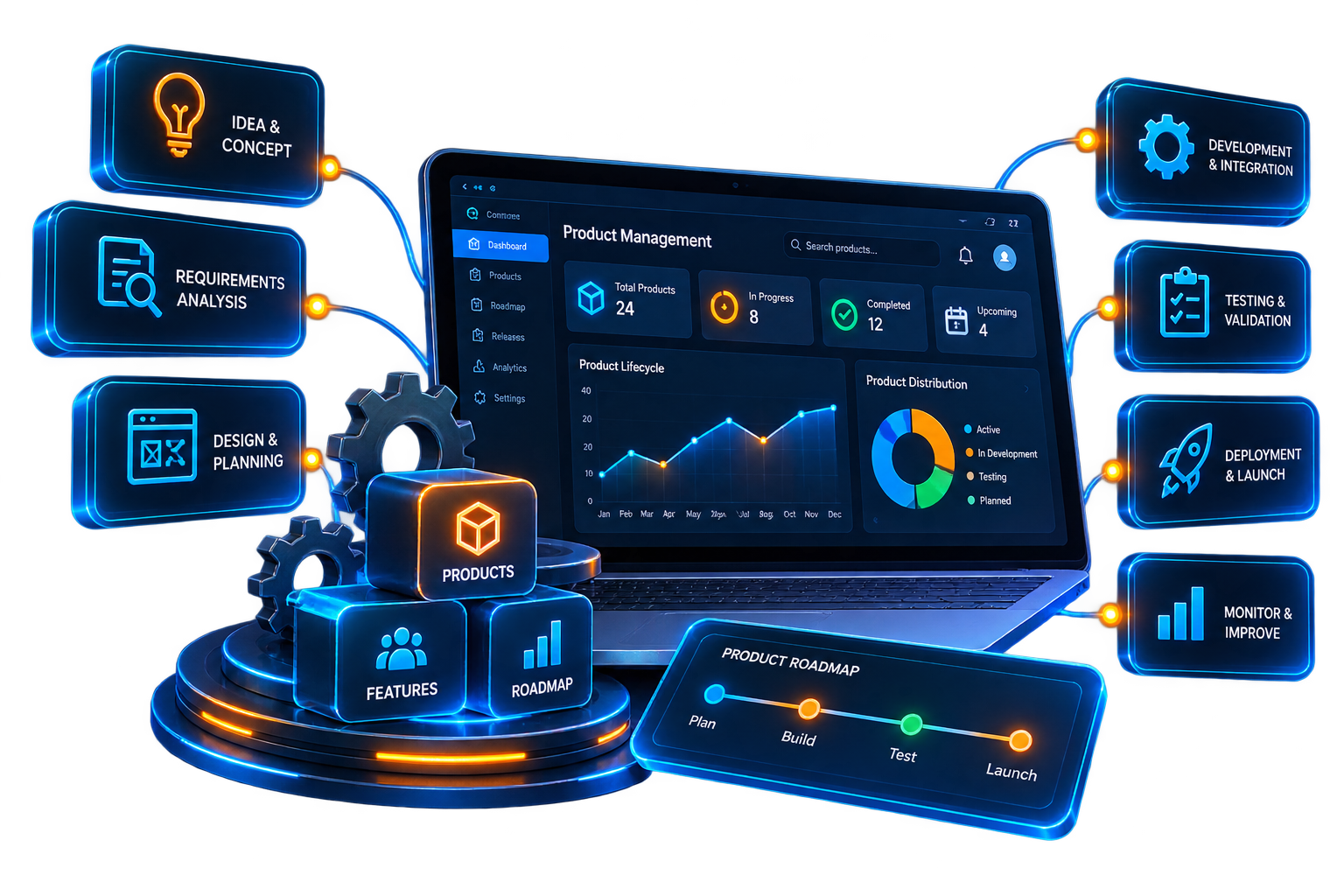
FEATURE DEVELOPMENT
Design, prioritize, build, and validate product features based on customer needs and business priorities.
A Step-by-Step Guide to Effective Feature Development
```Feature development transforms validated customer needs and business requirements into practical product capabilities. A structured development approach helps product teams define requirements, prioritize features, coordinate development, validate functionality, and deliver improvements that create measurable value.
-
Define Feature Objectives: Establish the purpose of each feature and identify the customer problem or business requirement it is intended to address.
-
Gather Requirements: Translate customer feedback, research findings, business requirements, and technical considerations into clear feature requirements.
-
Prioritize Features: Evaluate potential features based on customer value, business impact, effort, urgency, dependencies, and strategic importance.
-
Plan Development: Define the scope, acceptance criteria, dependencies, resources, milestones, and delivery approach for each feature.
-
Build and Validate: Develop the feature, perform appropriate testing, collect feedback, and verify that the delivered functionality meets its intended objectives.
Key Critical Factors for Successful Feature Development
Successful feature development requires a balance between customer value, business objectives, technical feasibility, development effort, and product quality. The following factors help teams deliver useful and maintainable features.
-
Clear Feature Requirements: Define what the feature should accomplish and establish clear expectations for its functionality.
-
Customer Value: Ensure the feature addresses a meaningful customer problem or provides a clear improvement to the product experience.
-
Business Alignment: Connect feature development with business objectives, product strategy, and measurable outcomes.
-
Technical Feasibility: Evaluate technical requirements, dependencies, scalability, security, and implementation effort before development begins.
-
Quality Validation: Test features thoroughly and verify that they meet requirements without negatively affecting existing product functionality.

Looking for Feature Development solutions?
Let�s turn your product requirements into valuable features.
Common Feature Development Challenges and How to Address Them
Product teams can face challenges when requirements are unclear, feature priorities constantly change, or development work is not aligned with customer and business needs. A structured feature development process helps teams manage these challenges effectively.
-
Unclear Requirements: Define detailed feature objectives, user needs, acceptance criteria, and expected outcomes before development begins.
-
Changing Priorities: Establish clear prioritization criteria and regularly review feature priorities against current product and business objectives.
-
Scope Expansion: Clearly define feature scope and manage additional requirements through a structured change process.
-
Technical Dependencies: Identify technical dependencies and integration requirements early to reduce development delays and unexpected issues.
-
Quality Issues: Include appropriate testing, validation, and user feedback throughout the development process to identify problems early.
Feature Prioritization and Planning
Not every requested feature should be developed immediately. Effective prioritization helps product teams focus development resources on features that provide the greatest customer and business value while considering effort, urgency, and technical feasibility.
-
Customer Impact: Evaluate how strongly the feature addresses customer needs or improves the user experience.
-
Business Value: Consider the potential contribution of the feature to business objectives, growth, efficiency, or customer retention.
-
Development Effort: Assess the estimated time, resources, complexity, and technical work required to deliver the feature.
-
Strategic Importance: Prioritize features that directly support important product and organizational goals.
-
Dependencies and Risks: Consider integrations, technical dependencies, operational risks, and other factors that may affect delivery.
Want to prioritize the right product features?
Let�s align feature priorities with customer value and business goals.
Minimum Viable Features and Incremental Development
```Developing features incrementally can help organizations deliver customer value sooner while learning from real usage and feedback. A focused feature scope allows teams to validate important functionality before investing in additional complexity.
-
Define Core Functionality: Identify the essential functionality required to solve the target customer problem effectively.
-
Reduce Unnecessary Complexity: Avoid adding functionality that does not contribute directly to the primary customer or business objective.
-
Release Incrementally: Deliver features in manageable stages so teams can collect feedback and make improvements based on real usage.
-
Validate Customer Value: Measure whether the delivered functionality actually solves the intended customer problem.
-
Expand Based on Evidence: Use customer feedback and product data to determine whether additional functionality should be developed.
Feature Testing and Quality Validation
Feature quality is essential for maintaining a reliable product experience. Testing should confirm that new functionality meets its requirements and works correctly within the existing product ecosystem.
-
Requirement Validation: Confirm that the feature meets the defined functional and business requirements.
-
Functional Testing: Verify that the feature performs its intended actions correctly across relevant scenarios.
-
Usability Testing: Evaluate whether users can understand and use the feature efficiently.
-
Integration Testing: Confirm that the new feature works correctly with relevant existing systems, services, and product components.
-
Regression Testing: Verify that new development does not negatively affect existing product functionality.
Ready to build features that deliver real value?
Let�s develop reliable, scalable, and customer-focused product features.
Using Customer Insights to Guide Feature Development
```Customer feedback and research provide important inputs for deciding which features should be developed and how they should work. Connecting customer insights with feature planning helps teams create functionality that addresses real problems.
-
Identify Feature Opportunities: Use customer feedback and research to discover functionality that could solve important customer problems.
-
Understand User Expectations: Identify how customers expect a feature to work and what outcomes they want to achieve.
-
Prioritize Customer Problems: Focus development resources on problems that have meaningful customer impact.
-
Validate Feature Concepts: Test feature ideas and prototypes with relevant users before investing heavily in development.
-
Improve Features Through Feedback: Use post-release feedback and product insights to continuously improve functionality.
Feature Development and Product Roadmaps
Feature development should be connected to the broader product roadmap. A well-managed roadmap helps teams understand which features are planned, why they matter, and how they contribute to longer-term product objectives.
-
Connect Features to Goals: Ensure every major feature contributes to a defined product or business objective.
-
Establish Development Priorities: Organize features according to customer value, strategic importance, effort, and dependencies.
-
Plan Delivery Milestones: Define realistic development stages and milestones for important feature initiatives.
-
Manage Dependencies: Identify relationships between features, systems, teams, integrations, and technical components.
-
Review Roadmap Performance: Regularly evaluate whether feature delivery is contributing to the intended product outcomes.
Need a stronger feature development strategy?
Let�s connect your product roadmap with customer and business priorities.
How to Measure Feature Development Effectiveness
```Feature development should be evaluated based on the value and outcomes it creates rather than simply the number of features delivered. Meaningful product metrics can help teams understand whether new functionality is achieving its purpose.
-
Feature Adoption: Measure how frequently target users discover and use newly released functionality.
-
User Engagement: Evaluate whether the feature contributes to meaningful user interactions and product engagement.
-
Customer Satisfaction: Monitor customer feedback and satisfaction to understand whether the feature improves the product experience.
-
Business Impact: Measure relevant business outcomes influenced by the feature, such as efficiency, conversion, retention, or growth.
-
Quality and Reliability: Track defects, support issues, performance, and reliability to ensure the feature continues to work effectively.
Continuous Improvement of Product Features
Feature development does not end when functionality is released. Continuous monitoring, customer feedback, usage analysis, and product evaluation help teams identify opportunities to improve existing features and create better experiences.
-
Monitor Feature Usage: Analyze how customers use new functionality and identify areas of high or low engagement.
-
Collect Post-Launch Feedback: Gather customer feedback after release to identify problems, expectations, and improvement opportunities.
-
Review Product Performance: Evaluate feature performance, reliability, usability, and business impact on a regular basis.
-
Refine Existing Features: Improve functionality based on customer behavior, feedback, product data, and changing requirements.
-
Align with Future Goals: Ensure feature improvements continue to support the evolving product roadmap and business strategy.
FEATURE DEVELOPMENT SOLUTIONS
Design, prioritize, develop, test, and validate product features based on customer needs, business objectives, and product strategy.
PRODUCT FEATURE DEVELOPMENT
Transform product requirements and customer insights into reliable, scalable, and valuable features that improve product experiences.