
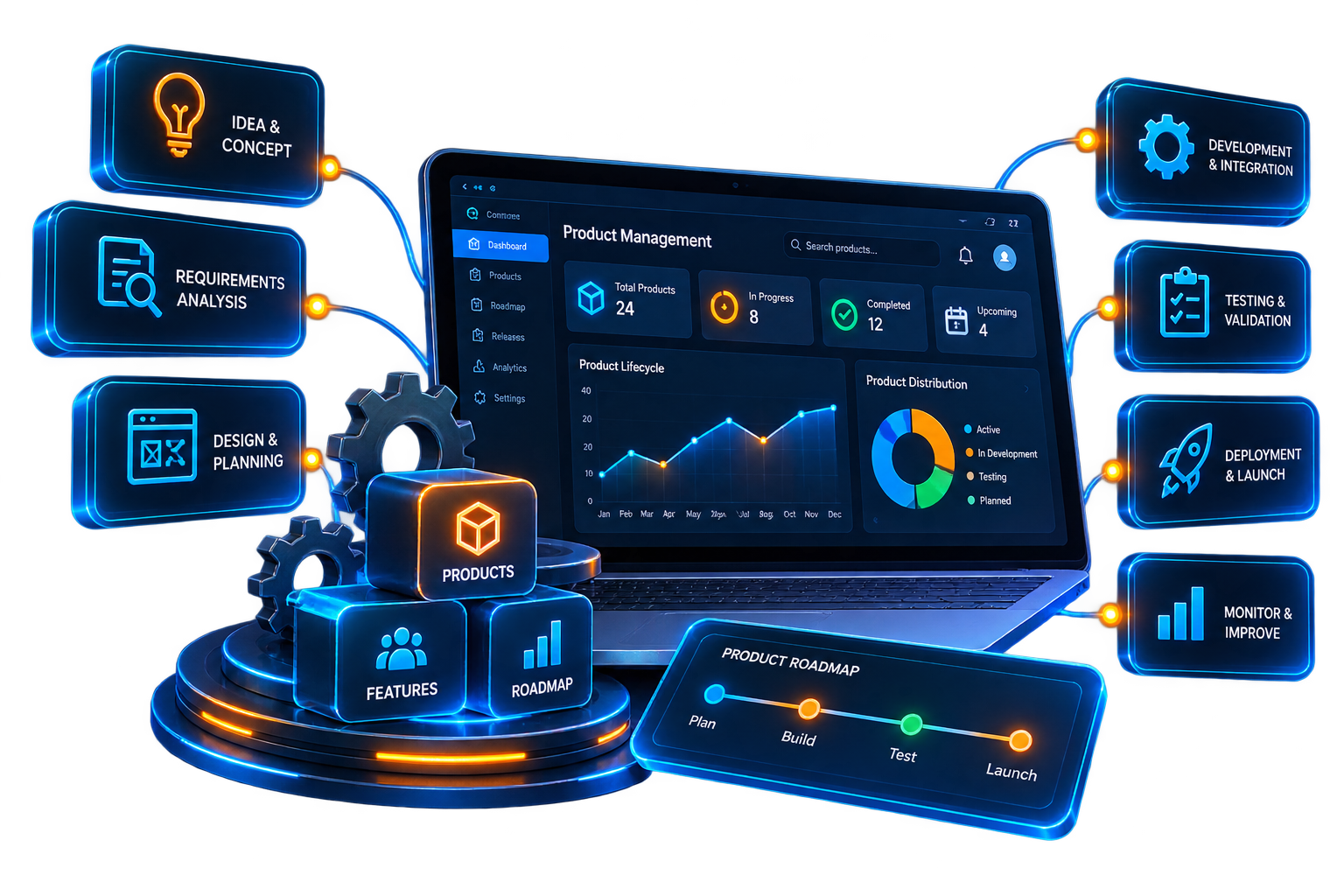
USER RESEARCH
Use structured user research to understand workflows, usability expectations, and product experience requirements.
A Step-by-Step Guide to Effective User Research
```User research helps organizations understand how people interact with products, services, systems, and workflows. A structured user research process provides valuable insights into user needs, behaviors, challenges, expectations, and experiences, helping product teams make better design and development decisions.
-
Define Research Objectives: Establish clear research goals and identify the questions that need to be answered about users and their product experiences.
-
Identify Target Users: Define the user groups, roles, customer types, or audiences that should participate in the research.
-
Understand User Needs: Explore user goals, expectations, motivations, pain points, requirements, and challenges.
-
Study User Workflows: Analyze how users complete tasks and interact with products, services, systems, and processes.
-
Convert Findings into Insights: Organize research observations into actionable insights that can guide product design, development, and experience improvements.
Key Critical Factors for Successful User Research
Effective user research requires a clear understanding of the people being studied and the context in which they use a product or service. The following factors help organizations collect useful and actionable user insights.
-
Clear Research Questions: Define focused questions that directly support product, usability, customer experience, and business decisions.
-
Representative Users: Include users who accurately represent the intended audience, roles, workflows, and usage scenarios.
-
Real-World Context: Study users in realistic situations to understand how products and workflows are actually used.
-
Unbiased Research: Avoid leading questions and assumptions so research findings reflect genuine user experiences and opinions.
-
Actionable Findings: Translate research observations into clear recommendations that product and development teams can apply.

Looking for User Research solutions?
Let�s understand your users and improve your product experience.
Common User Research Challenges and How to Address Them
User research can become difficult when teams have limited access to users, unclear research objectives, inconsistent feedback, or difficulty converting observations into product decisions. A structured research approach helps organizations overcome these challenges.
-
Limited User Participation: Establish suitable research channels and make participation simple and relevant for target users.
-
Unclear User Needs: Use interviews, observation, surveys, and usability activities to understand the underlying needs behind user requests.
-
Conflicting Feedback: Compare feedback across different users and identify recurring patterns instead of relying on isolated opinions.
-
Research Bias: Use neutral questions, consistent research processes, and multiple sources of evidence to reduce bias.
-
Difficulty Applying Insights: Organize findings into clear themes, priorities, and recommendations that product teams can use.
User Research Methods
Different research methods provide different types of user insights. Selecting the appropriate methods based on the research objective helps teams understand both what users say and how they actually interact with products and services.
-
User Interviews: Conduct direct conversations with users to understand their goals, problems, expectations, motivations, and experiences.
-
User Surveys: Collect structured feedback from a broader audience to identify trends, preferences, satisfaction levels, and common concerns.
-
Usability Testing: Observe users completing tasks to identify usability problems, confusing workflows, and areas that require improvement.
-
User Observation: Study users in their normal environment to understand real workflows, behaviors, constraints, and product interactions.
-
Feedback Analysis: Review support requests, reviews, comments, and other user feedback to identify recurring experience problems.
Want to understand how users really interact with your product?
Let�s identify usability challenges and improve the overall user experience.
Understanding User Needs and Workflows
```Understanding user workflows provides product teams with valuable information about how users complete tasks and where difficulties occur. Studying the complete user journey can reveal opportunities to simplify processes, improve usability, and create more efficient product experiences.
-
Identify User Goals: Understand what users are trying to accomplish and the outcomes they expect from the product.
-
Map User Workflows: Document the steps users follow to complete important tasks and identify unnecessary complexity.
-
Identify Pain Points: Discover points where users experience confusion, delays, errors, frustration, or additional effort.
-
Understand User Expectations: Identify what users expect from product features, workflows, interfaces, communication, and support.
-
Prioritize Experience Improvements: Use research findings to identify which usability and workflow improvements should be addressed first.
Using User Research for Product Development
User research can influence product decisions throughout the development lifecycle. By connecting research findings with product planning, teams can create solutions that better match real user needs and reduce unnecessary development effort.
-
Define Product Requirements: Use user needs and workflow insights to create requirements that reflect real user problems.
-
Prioritize Features: Evaluate features based on user value, business objectives, usability, and the importance of the underlying user problem.
-
Improve User Experience: Use usability findings to simplify interfaces, navigation, workflows, and interactions.
-
Validate Design Decisions: Test proposed designs and workflows with representative users before wider implementation.
-
Support Product Roadmaps: Connect user research findings with product priorities and future development plans.
Ready to build a user-focused product?
Let�s turn user research into practical product and experience improvements.
Improving Usability Through User Research
```Usability research helps organizations understand whether users can complete important tasks efficiently and confidently. By identifying usability barriers early, product teams can improve interfaces and workflows before problems become more difficult and expensive to address.
-
Evaluate Task Completion: Determine whether users can successfully complete important tasks using the product.
-
Identify Navigation Issues: Analyze whether users can easily find information, features, and actions within the product.
-
Reduce User Effort: Identify unnecessary steps and simplify workflows to make common tasks easier to complete.
-
Improve Interface Clarity: Identify confusing labels, instructions, layouts, or interactions that may affect user understanding.
-
Validate Improvements: Test updated designs with users to determine whether usability problems have been reduced.
How to Measure User Research Effectiveness
User research should contribute to measurable improvements in product usability, customer experience, and decision-making. Tracking relevant indicators helps organizations understand whether research findings are creating practical value.
-
Task Completion: Measure whether users can complete important product tasks successfully.
-
User Satisfaction: Track user satisfaction and feedback to understand how users perceive the product experience.
-
Usability Improvements: Monitor whether identified usability problems are reduced after product improvements are implemented.
-
User Engagement: Analyze meaningful interactions and usage patterns to understand how users engage with the product.
-
Research Impact: Evaluate how research findings influence product requirements, feature priorities, design decisions, and development plans.
Continuous User Research and Improvement
User needs and behaviors can change as products, technologies, markets, and customer expectations evolve. Continuous user research helps organizations maintain alignment with users and identify new opportunities for improvement.
-
Monitor User Feedback: Continuously review feedback, support interactions, reviews, and other user responses.
-
Track Changing Behaviors: Analyze changes in user workflows, product usage, engagement, and expectations.
-
Revalidate User Needs: Periodically confirm that existing product requirements continue to address genuine user problems.
-
Test Product Improvements: Validate major changes with users before wider implementation whenever practical.
-
Align with Product Strategy: Ensure user research continues to influence product priorities, customer experience, and long-term development goals.
USER RESEARCH SOLUTIONS
Understand user needs, workflows, behaviors, expectations, and usability challenges through structured user research.
USER EXPERIENCE & USABILITY RESEARCH
Transform user feedback and behavioral insights into actionable improvements for product design, usability, workflows, and customer experience.