
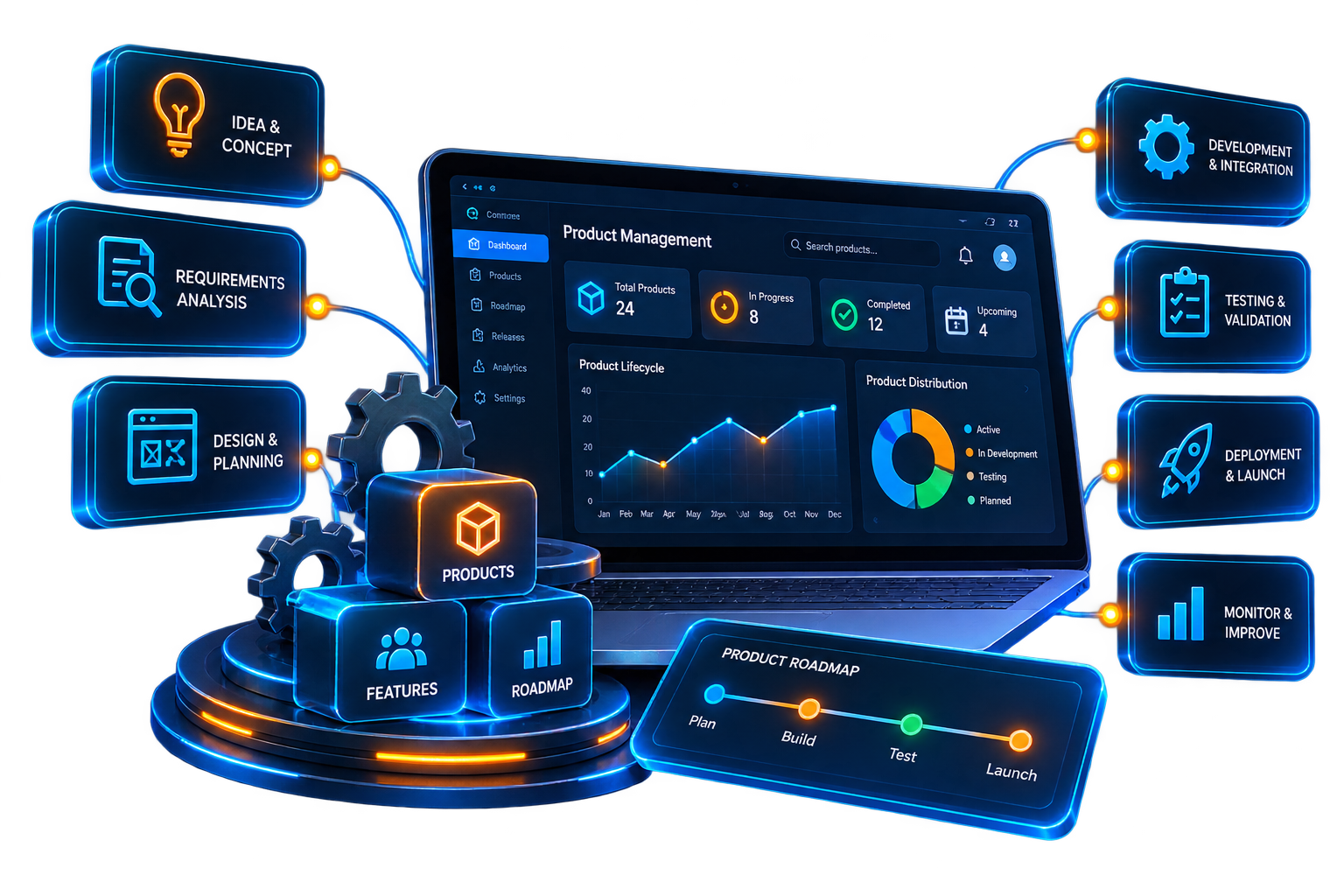
PRODUCT ENGINEERING
Build scalable and maintainable product solutions with engineering practices aligned to product goals.
Product Engineering
```Build scalable and maintainable product solutions with engineering practices aligned to product goals. Our product management approach connects strategy, customer insight, execution, and measurable outcomes to help organizations build and improve successful digital products.
-
Define clear objectives and requirements for product engineering.
-
Align customer needs, business priorities, and delivery activities around product engineering.
-
Use structured planning, measurable outcomes, and continuous feedback to improve results.
-
Create a scalable approach that supports long-term product success and operational efficiency.
A Step-by-Step Guide to Effective Product Engineering
```Product engineering connects product strategy with technology, design, development, testing, deployment, and ongoing improvement. A structured engineering process helps organizations transform product requirements into reliable and scalable digital solutions.
1. Understand Product Requirements: Start by understanding customer requirements, business objectives, product priorities, and technical expectations. Clear requirements provide direction for engineering teams.
2. Define the Technical Architecture: Establish an appropriate architecture based on product requirements, expected usage, integrations, security, performance, and future scalability.
3. Plan Engineering Activities: Break product requirements into technical tasks, development milestones, dependencies, and release activities. Effective planning helps teams manage complexity and delivery.
4. Develop Product Components: Build frontend interfaces, backend services, databases, APIs, integrations, and other required components using maintainable engineering practices.
5. Test and Validate: Perform functional, integration, performance, security, and usability testing to verify that the product meets its requirements and quality expectations.
6. Deploy and Monitor: Release the product through appropriate deployment processes and continuously monitor application performance, reliability, availability, and customer experience.
7. Optimize and Improve: Use technical metrics, customer feedback, product analytics, and operational insights to identify opportunities for optimization and future development.
Key Critical Factors for Successful Product Engineering
```Strong product engineering requires a balance between product requirements, technical quality, development speed, scalability, and long-term maintainability. Engineering decisions should support both immediate product objectives and future business growth.
-
Scalable Architecture: Design technical systems that can support increasing users, data, features, and integrations.
-
Maintainable Code: Follow clear coding practices that make applications easier to understand, test, modify, and extend.
-
Product Alignment: Ensure engineering decisions directly support customer needs and product priorities.
-
Quality Engineering: Integrate testing and quality practices throughout the product development lifecycle.
-
Security: Consider application, data, authentication, authorization, and infrastructure security throughout development.
-
Performance: Optimize applications and technical components to provide reliable and responsive product experiences.
Looking for Product Engineering solutions?
Build scalable, reliable, and maintainable digital products with engineering practices aligned with customer needs and business objectives.
Get StartedCommon Product Engineering Challenges and How to Address Them
```Product engineering teams often need to balance rapid product delivery with technical quality, scalability, security, and maintainability. Identifying engineering challenges early can reduce development risks and improve long-term product performance.
Technical Debt: Rapid development without appropriate engineering practices can create technical debt. Regular refactoring, code reviews, documentation, and technical improvements can help maintain product quality.
Scalability Problems: Systems that work effectively with a small user base may experience performance limitations as usage increases. Architecture and infrastructure should be designed with realistic growth requirements in mind.
Integration Complexity: Modern products often depend on APIs, third-party services, enterprise systems, and external platforms. Clear integration planning and appropriate error handling can reduce integration-related issues.
Quality Issues: Insufficient testing can lead to defects reaching customers. Automated testing, code reviews, continuous integration, and structured quality assurance can improve reliability.
Changing Product Priorities: Product requirements can evolve based on customer feedback and market conditions. Close collaboration between product and engineering teams helps teams respond while maintaining technical stability.
Technical Architecture and Scalable Product Solutions
```Technical architecture provides the foundation for a product's performance, reliability, security, and scalability. Architecture decisions should be based on product requirements, expected workloads, integrations, data requirements, and future growth.
Engineering teams can evaluate appropriate application structures, databases, APIs, cloud infrastructure, caching strategies, authentication mechanisms, and integration patterns based on the product's requirements.
-
Design architecture according to current and future product requirements.
-
Establish reliable application and database structures.
-
Plan APIs and integrations for maintainability and reliability.
-
Consider performance, security, availability, and scalability from the beginning.
Want to build a scalable product architecture?
Establish a strong technical foundation that supports product growth, reliable performance, secure operations, and future enhancements.
Discuss Your ProductAgile Engineering and Continuous Delivery
```Agile engineering practices allow product teams to develop and release improvements in smaller and more manageable increments. Development activities can be organized around prioritized product requirements and measurable release objectives.
Continuous integration and delivery practices can help teams identify development issues earlier and streamline the process of moving tested changes toward production. Automated build, testing, and deployment processes can improve delivery consistency.
Regular collaboration between product managers, designers, developers, testers, and operations teams helps ensure that technical implementation remains aligned with product priorities.
Quality Engineering, Testing and Reliability
```Quality engineering should be integrated throughout the product lifecycle. Testing helps teams identify functional defects, integration problems, performance limitations, security risks, and usability issues before they significantly affect customers.
Different testing approaches can be applied according to product requirements, including unit testing, integration testing, system testing, regression testing, performance testing, and user acceptance testing.
-
Validate product functionality against defined requirements.
-
Verify integrations and API communication between systems.
-
Identify performance and reliability issues before production release.
-
Maintain regression testing as the product evolves.
Ready to improve product quality and reliability?
Integrate engineering quality practices throughout development to create stable, reliable, and maintainable digital products.
Start Your EngineeringProduct Security and Performance Engineering
```Security and performance are important considerations for modern digital products. Engineering teams should evaluate security requirements and performance expectations throughout product development rather than treating them as final-stage activities.
Secure authentication, authorization, data protection, input validation, dependency management, and appropriate monitoring can help reduce application security risks. Performance engineering can focus on response times, resource utilization, database efficiency, and application behavior under expected workloads.
Continuous monitoring provides engineering teams with information about system health and helps identify potential problems before they have a significant impact on users.
Product Engineering and Long-Term Maintainability
```Long-term product success depends on the ability to maintain and evolve the technology as customer requirements and business priorities change. Maintainable systems allow engineering teams to introduce enhancements, fix defects, and respond to new requirements more efficiently.
Clear architecture, modular components, readable code, appropriate documentation, automated testing, version control, and regular technical improvements can reduce the complexity of future development.
Engineering teams should periodically review technical performance, dependencies, architecture, and code quality to identify areas that require optimization or modernization.
How to Measure Product Engineering Effectiveness
```Product engineering effectiveness can be measured through a combination of development, quality, reliability, performance, and business-oriented metrics. These measurements help teams understand whether engineering activities are supporting product objectives.
-
Development cycle time and deployment frequency.
-
Release success rate and delivery predictability.
-
Defect rates and production issue frequency.
-
Application performance and response times.
-
System availability and reliability.
-
Customer satisfaction and product adoption.
-
Technical debt and maintainability improvements.
Continuous Improvement of Product Engineering
```Product engineering should continuously evolve as products grow, technologies change, and customer requirements become more complex. Engineering teams can use technical metrics, customer feedback, production data, and development insights to identify opportunities for improvement.
Regular architecture reviews, code quality improvements, dependency updates, performance optimization, security reviews, and automated testing can help maintain the health of the product over time.
By combining strong engineering practices with product strategy and customer insight, organizations can create technology solutions that remain reliable, adaptable, and capable of supporting long-term business growth.
PRODUCT ENGINEERING SOLUTIONS
Build scalable and maintainable digital products through strong architecture, development, testing, deployment, and continuous engineering improvement.
Learn MoreDIGITAL PRODUCT ENGINEERING
Transform product requirements into reliable technology solutions with customer-focused engineering, scalable architecture, quality practices, and measurable outcomes.
Learn More