
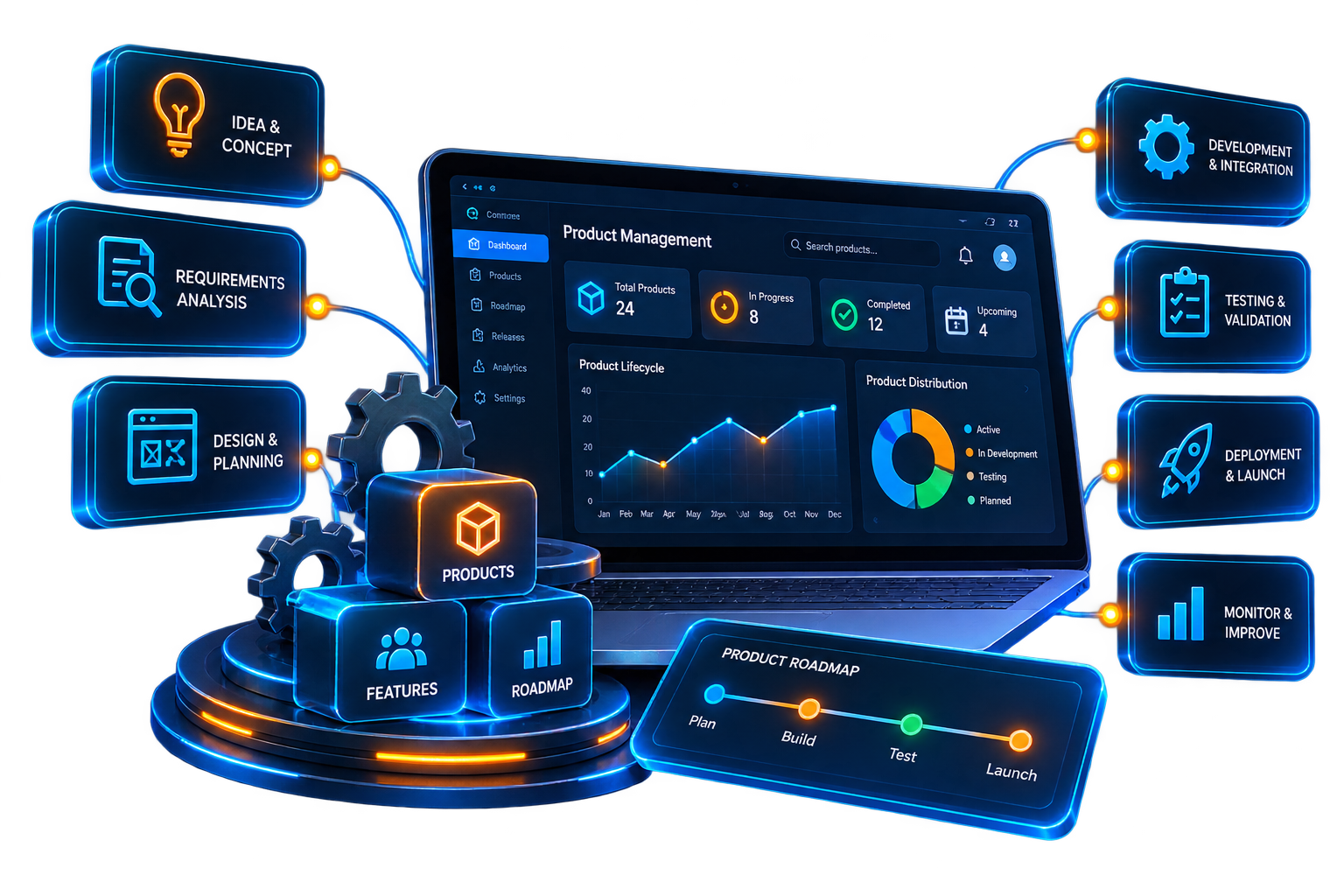
PRODUCT DEVELOPMENT & LAUNCH
Turn validated ideas into market-ready products through structured planning, development, testing, and launch preparation.
Product Development & Launch
```Turn validated ideas into market-ready products through structured planning, development, testing, and launch preparation. Our product management approach connects strategy, customer insight, execution, and measurable outcomes to help organizations build, launch, and improve successful digital products.
-
Define clear objectives and requirements for product development & launch.
-
Align customer needs, business priorities, and delivery activities around product development & launch.
-
Use structured planning, measurable outcomes, and continuous feedback to improve results.
-
Create a scalable approach that supports long-term product success and operational efficiency.
A Step-by-Step Guide to Product Development & Launch
```Successfully taking a product from a validated concept to the market requires coordination across product strategy, design, engineering, testing, marketing, operations, and customer support. A structured process helps organizations reduce launch risks and create a stronger foundation for long-term growth.
1. Define Product Objectives: Establish the business goals, target customers, product vision, value proposition, and expected outcomes. Clear objectives provide direction for development and launch activities.
2. Finalize Product Requirements: Convert validated customer needs into clear functional and technical requirements. Prioritize features based on customer value, business impact, development effort, and launch objectives.
3. Create the Development Roadmap: Establish milestones, development phases, dependencies, testing activities, release targets, and responsibilities. A detailed roadmap helps teams coordinate activities and manage delivery timelines.
4. Design and Build the Product: Develop the user experience, interface, backend services, integrations, and technical components required for the planned product release.
5. Test and Validate: Perform functional, usability, performance, security, and integration testing. Product validation helps identify critical issues before the market launch.
6. Prepare for Launch: Coordinate product documentation, marketing materials, customer support, deployment processes, training, analytics, and operational readiness.
7. Launch and Monitor: Release the product to the target market and continuously monitor adoption, customer feedback, performance, and business results.
8. Improve After Launch: Use customer insights and product data to prioritize improvements, fix issues, introduce new capabilities, and optimize the overall product experience.
Key Critical Factors for a Successful Product Launch
```A successful launch depends on more than completing development. Product teams need to ensure that the product, technology, operations, customers, and internal teams are prepared for the market release.
-
Product Readiness: Ensure that the product delivers the expected functionality and customer value.
-
Technical Readiness: Validate infrastructure, integrations, security, performance, and deployment requirements.
-
Customer Readiness: Provide customers with clear information, onboarding resources, and support.
-
Team Alignment: Ensure product, development, marketing, sales, operations, and support teams understand the launch plan.
-
Launch Strategy: Establish clear positioning, communication, distribution, and customer acquisition activities.
-
Measurement: Define key performance indicators to evaluate launch performance and customer response.
Looking for Product Development & Launch solutions?
Transform validated product ideas into market-ready solutions through structured development, testing, launch planning, and continuous improvement.
Get StartedCommon Product Development & Launch Challenges
```Moving from product development to a successful market launch can introduce several challenges. Managing these challenges early can help organizations reduce delays, improve product quality, and create a better launch experience.
Changing Requirements: Customer and business requirements can change during development. Maintaining a prioritized product backlog and roadmap helps teams manage changes without losing focus.
Development Delays: Technical dependencies, resource constraints, integration problems, and unexpected defects can affect launch schedules. Regular progress reviews and risk management help teams identify potential delays earlier.
Insufficient Testing: Releasing a product without adequate testing can result in usability problems, performance issues, or functional defects. Comprehensive validation before launch helps reduce these risks.
Poor Launch Coordination: Product, marketing, sales, support, and operations teams need to work from a common launch plan. Clear responsibilities and communication help prevent operational gaps.
Limited Customer Adoption: A technically successful product may still struggle if customers do not understand its value. Clear positioning, onboarding, communication, and customer support can improve adoption.
Product Roadmap and Launch Planning
```A product roadmap provides a structured view of the product's development priorities and future direction. For a launch, the roadmap should connect development milestones with testing, operational preparation, marketing, and customer readiness activities.
Launch planning can be divided into preparation, release, and post-launch stages. Each stage should have clearly defined responsibilities, deadlines, dependencies, and success criteria.
-
Define product milestones and release objectives.
-
Identify technical and operational dependencies.
-
Coordinate launch activities across relevant teams.
-
Establish launch readiness and success criteria.
Want to prepare your product for a successful launch?
Build a coordinated product roadmap that connects development, testing, launch readiness, customer adoption, and business goals.
Discuss Your ProductProduct Testing and Launch Readiness
```Launch readiness requires teams to verify that the product is technically stable and capable of delivering the expected customer experience. Testing should cover the most important product workflows, integrations, and operational scenarios.
Functional testing verifies that product features work according to requirements. Integration testing ensures that connected systems and services communicate correctly. Performance testing can help identify issues that may occur under expected usage conditions.
User acceptance testing also provides an opportunity for representative users or stakeholders to validate important workflows before the product is released to a broader audience.
-
Validate critical product workflows.
-
Verify integrations and external dependencies.
-
Evaluate product performance and reliability.
-
Complete user acceptance and launch-readiness testing.
Go-to-Market and Customer Launch Strategy
```A product launch should clearly communicate the problem the product solves, the value it provides, and why customers should choose it. Product teams should work with marketing, sales, and customer-facing teams to establish consistent messaging.
Launch activities can include customer communications, product demonstrations, onboarding resources, sales enablement materials, documentation, promotional campaigns, and support preparation depending on the product and target market.
Understanding the target audience and selecting the appropriate communication channels can help organizations reach potential customers more effectively and create stronger awareness around the product.
Ready to take your product to market?
Coordinate product development, launch preparation, customer communication, and market readiness to create a stronger product launch experience.
Start Your LaunchPost-Launch Monitoring and Product Optimization
```Product development continues after launch. Monitoring customer behavior, feedback, support requests, product performance, and business results provides valuable information about how the product performs in the market.
Teams can use these insights to identify usability issues, performance problems, frequently requested improvements, and opportunities for additional features. Post-launch monitoring helps ensure that product decisions remain connected to real customer needs.
Regular reviews of product data and customer feedback can also help organizations determine whether the product is meeting its original objectives and where additional investment may generate the greatest value.
How to Measure Product Launch Effectiveness
```Measuring launch performance helps organizations understand customer response and identify opportunities for improvement. Metrics should be aligned with the product's objectives and business model.
-
Product adoption and customer acquisition.
-
Activation and onboarding completion rates.
-
Customer engagement and feature usage.
-
Customer satisfaction and feedback.
-
Conversion and retention performance.
-
Product revenue and business outcomes.
-
Product performance, reliability, and support requirements.
Continuous Improvement After Product Launch
```A successful launch is the beginning of the next stage of product growth. Organizations should continue collecting customer feedback, reviewing product analytics, monitoring technical performance, and evaluating business results after release.
Post-launch insights can be used to prioritize product enhancements, improve existing features, resolve usability issues, optimize customer journeys, and identify new market opportunities.
By establishing a continuous improvement cycle, organizations can ensure that their products remain relevant as customer expectations, market conditions, and business requirements evolve.
PRODUCT DEVELOPMENT & LAUNCH SOLUTIONS
Transform validated product concepts into market-ready solutions through structured development, testing, launch planning, and post-launch optimization.
Learn MorePRODUCT LAUNCH MANAGEMENT
Coordinate product readiness, release activities, customer communication, launch execution, and performance measurement for successful market entry.
Learn More